Design decision
Why this idea works
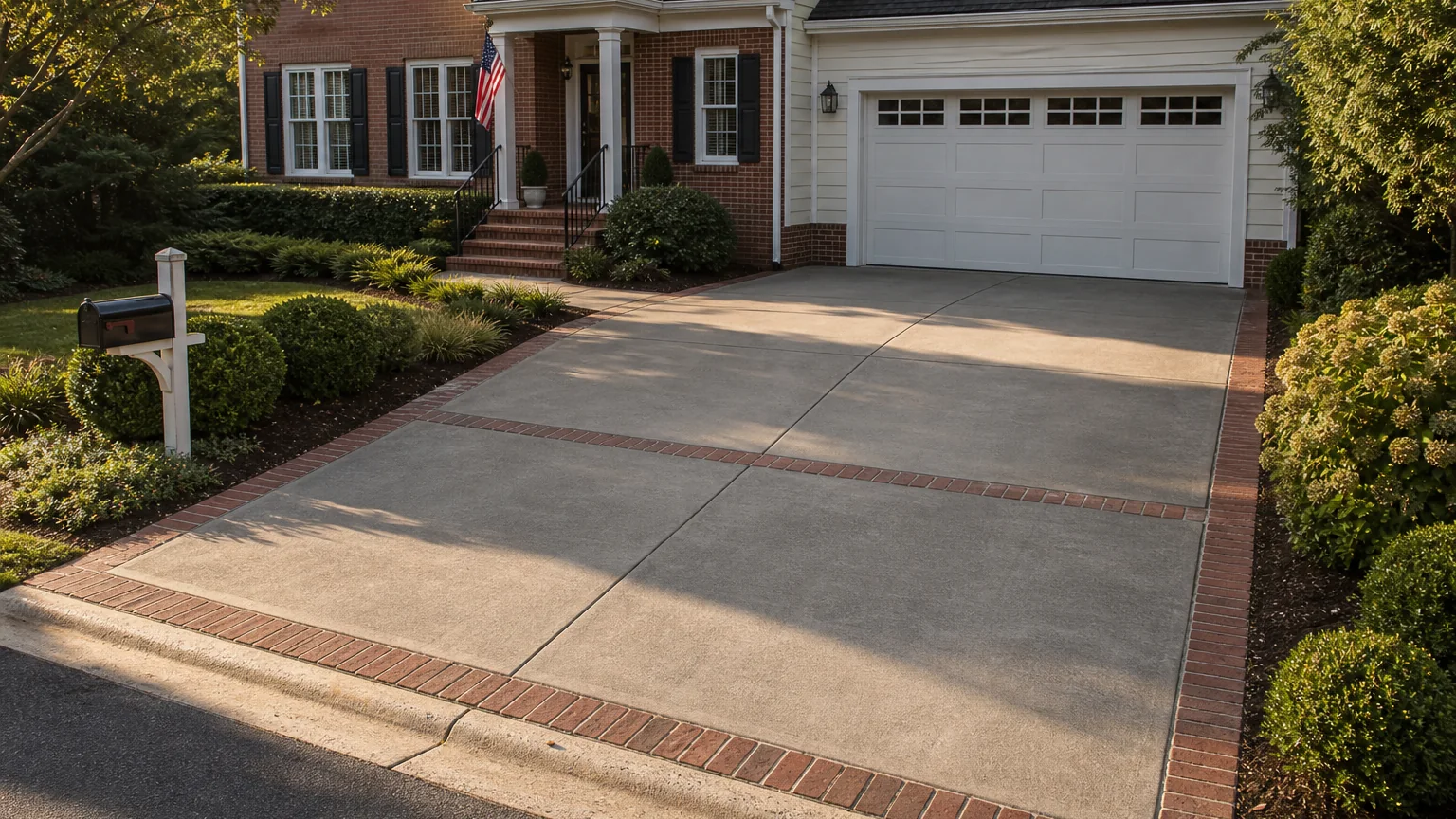
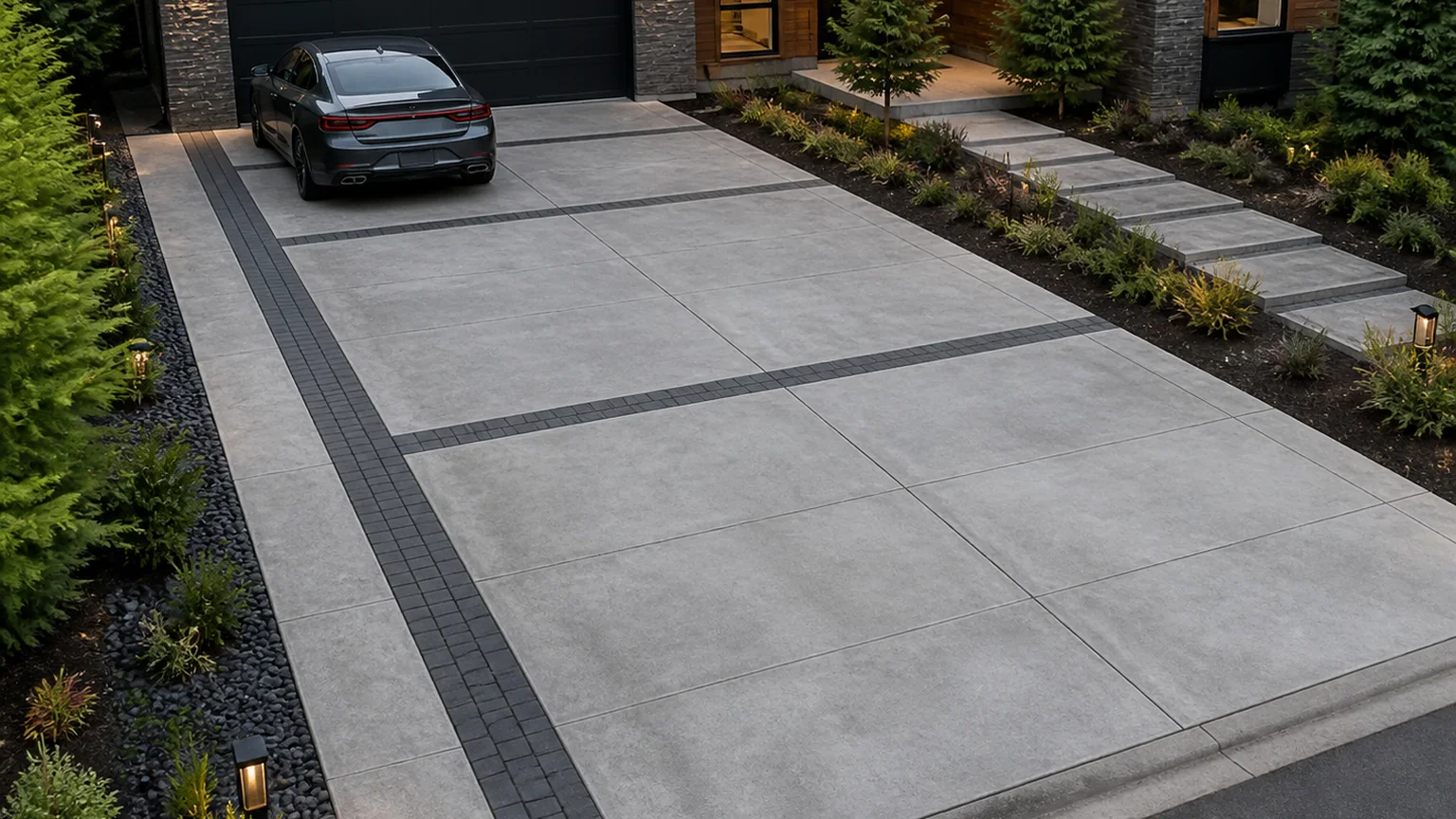
Dark inset bands give you a reason to place joints exactly where the design wants them, so the lines that control cracking also carry the pattern. Set flush and evenly, the bands add depth without adding maintenance, and they keep the pale field from reading as a blank expanse.
- The tradeoff
- Inset bands add strong detail and more edge work. Poor support or drainage can let the two materials move out of plane.
- How to measure it
- Conceptual range: one driveway rectangle, with the inset bands planned into the joint grid rather than added as decoration.
On your property
Plan it for your site
Keep the concrete field a quiet, even tone so the dark bands do the talking, and set every paver or insert flush so tires and a snow shovel pass over without catching. Detail the band as a real joint line, not a surface stripe, so it moves with the slab instead of fighting it.
- Align the inset bands with the control joints so the pattern and the crack control are the same lines.
- Set the pavers or bands flush and on a stable base so they do not heave or trap water.
- Keep the paving surface sloped for drainage across the bands, not just the concrete.
Before forms are set
Build implications
- Confirm before estimating Band locations that match the planned control-joint layout.
- Confirm before estimating A flush, stable detail where concrete meets the darker material.
- Confirm before estimating Drainage carried across the whole surface including the inset lines.
- Measure the site and establish elevations Record boundaries, thresholds, grade changes, utilities, and the dimensions of vehicles, furniture, equipment, or structures that affect the layout.
- Test how the space will be used Check walking routes, turning paths, door swings, working clearances, maintenance access, and the route back to the house or street.
- Resolve drainage, services, and structural support Decide where water goes and coordinate drains, conduit, irrigation, fuel, electrical work, footings, and independent supports before forms are set.
- Define and estimate each concrete element Confirm the slab or footing section, base, joints, edges, and finish, then estimate simple measurable fields separately from steps, walls, drains, and supported features.
Prevent these problems
- Bands that fight the joint planA band placed away from a needed joint can restrain the slab or create a narrow concrete strip beside it.
What changes the work and quote
- Accent material, edge forming, and flush installationKeep it simpler: Use saw-cut bands or fewer full-depth accents on the main joint lines.
Next step
Turn the idea into your estimate
Enter the dimensions and section for your property. The image does not provide a takeoff.
Estimate your drivewayQuestions this idea raises
Do inset bands weaken the slab?
Placed on the joint lines the slab needs anyway, they do not add weakness; they mark where movement is already planned. Set off the joint lines, they can create odd restraint, so coordinate the pattern with the jointing.
Will the pavers stay flush over time?
They will if they sit on a properly compacted base and the joint is detailed to drain, the same discipline the main slab needs. Skimp on the base and any edge material can lift.
- Best when
- The house already uses dark trim or masonry and the accent bands can sit on planned joint lines.
- Reconsider when
- Raised bands, loose units, or extra joints would interrupt tires, shovels, or an accessible walking route.
- Verify first
- Draw the structural joint grid, then place each dark band on a line the slab already needs.
- Professional input
- A concrete contractor should confirm the slab, base, joints, and drainage. Ask an engineer or the local authority to review retaining work, structures, unusual loads, or public-right-of-way changes.
Sources and further reading
- NRMCA CIP 6: Joints in Concrete Slabs on GradeJoint spacing, panel shape, isolation, and saw-cut depth for slabs on grade.
- FHWA: Bases and Subbases for Concrete PavementsProfessional guidance on uniform support, subgrade risks, drainage, and stable base layers.