Design decision
Why this idea works
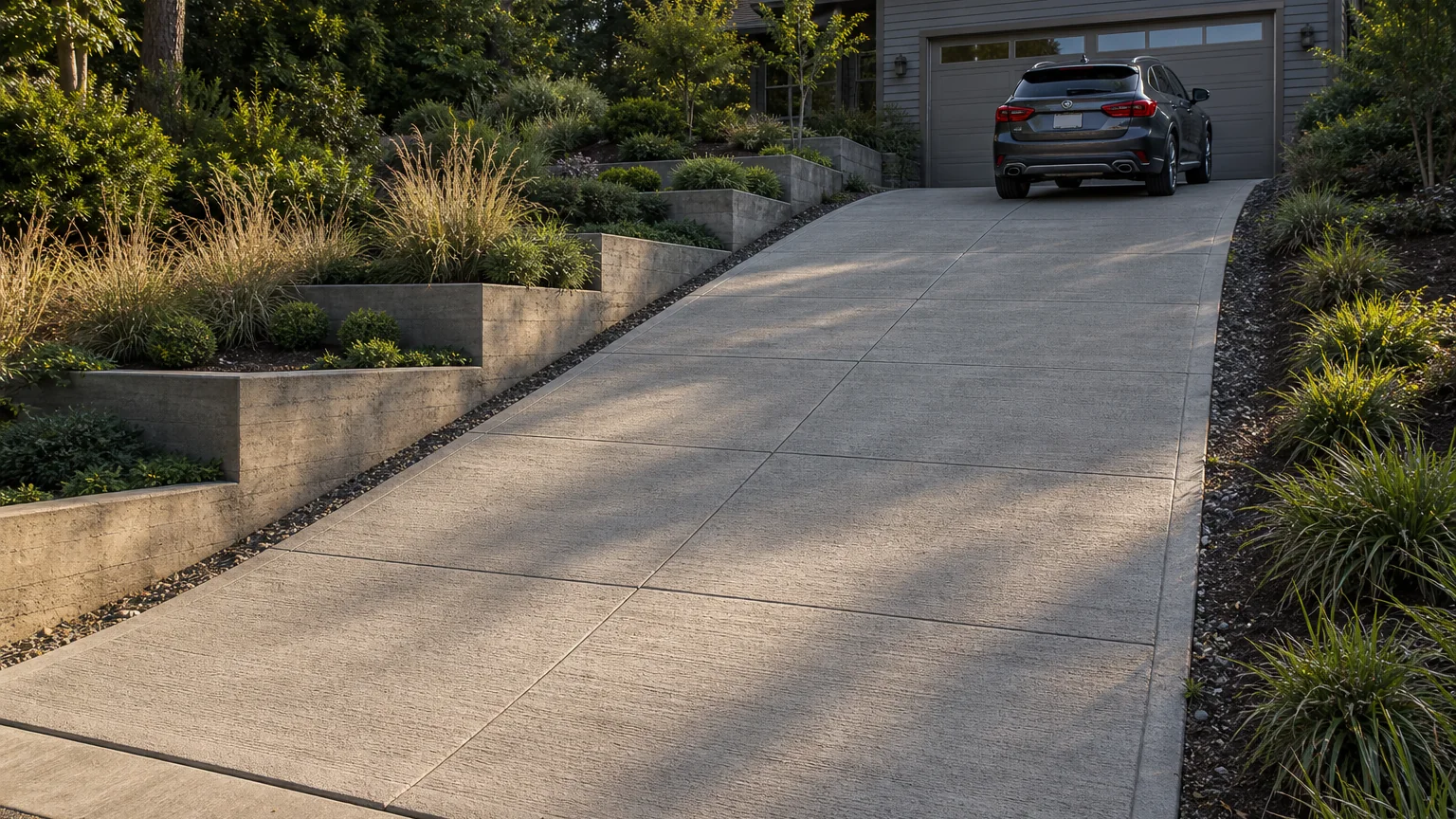
A driveway on a slope has to manage the grade honestly, and stepping the adjacent landscape into low terraces holds the bank, controls runoff, and makes the climb feel considered. The terraces resolve the hillside so the drive has stable ground on either side.
- The tradeoff
- Terraces make a slope look ordered, but they add retaining structures, drains, and maintenance beside the pavement.
- How to measure it
- Conceptual range: the sloped driveway run plus separately measured terrace walls by length and height.
On your property
Plan it for your site
Keep the drive a broom field with enough texture for traction on the grade, and detail the terraces as real retaining elements with drainage. Set the slope so vehicles clear it without scraping and so water sheds off rather than running down the drive.
- Confirm the drive slope clears vehicles without scraping and gives traction on the grade.
- Build the terraces as real retaining walls with footings and back drainage.
- Route runoff off the drive and behind the terraces so water does not run down the slope.
Before forms are set
Build implications
- Confirm before estimating A drive slope that clears vehicles and grips.
- Confirm before estimating Terrace walls with footings and drainage sized for their height.
- Confirm before estimating Runoff routed off the drive and behind the walls.
- Measure the site and establish elevations Record boundaries, thresholds, grade changes, utilities, and the dimensions of vehicles, furniture, equipment, or structures that affect the layout.
- Test how the space will be used Check walking routes, turning paths, door swings, working clearances, maintenance access, and the route back to the house or street.
- Resolve drainage, services, and structural support Decide where water goes and coordinate drains, conduit, irrigation, fuel, electrical work, footings, and independent supports before forms are set.
- Define and estimate each concrete element Confirm the slab or footing section, base, joints, edges, and finish, then estimate simple measurable fields separately from steps, walls, drains, and supported features.
Prevent these problems
- Treating terrace walls as decorationWater and soil pressure can move low walls into the drive when support and drainage are missing.
What changes the work and quote
- Excavation, retaining work, drainage, and slope stabilizationKeep it simpler: Use a graded planted bank where the site can remain stable without walls.
Next step
Turn the idea into your estimate
Enter the dimensions and section for your property. The image does not provide a takeoff.
Estimate your drivewayQuestions this idea raises
How steep can a driveway be?
Steep enough varies by climate and vehicle, but a grade that scrapes bumpers or ices dangerously is too much; transitions at the top and bottom matter as much as the slope itself. Confirm the grade for your vehicles and winters.
Do the terraces need engineering?
Low terraces on stable ground may be within a competent installer, but taller walls or ones holding a real grade become structural. Confirm the height threshold and involve a professional where the load calls for it.
- Best when
- The drive can hold a steady grade while separate terraces manage the adjacent slope and water.
- Reconsider when
- The terraces retain significant soil or the drive exceeds safe local grade and winter-use limits.
- Verify first
- Survey the profile and have each retaining edge, drain, and overflow path designed before grading.
- Professional input
- A concrete contractor should confirm the slab, base, joints, and drainage. Ask an engineer or the local authority to review retaining work, structures, unusual loads, or public-right-of-way changes.
Sources and further reading
- NRMCA CIP 6: Joints in Concrete Slabs on GradeJoint spacing, panel shape, isolation, and saw-cut depth for slabs on grade.
- FHWA: Bases and Subbases for Concrete PavementsProfessional guidance on uniform support, subgrade risks, drainage, and stable base layers.
- U.S. EPA: Types of Green InfrastructureHow rain gardens, swales, and permeable pavement store, slow, or infiltrate runoff.