Design decision
Why this idea works
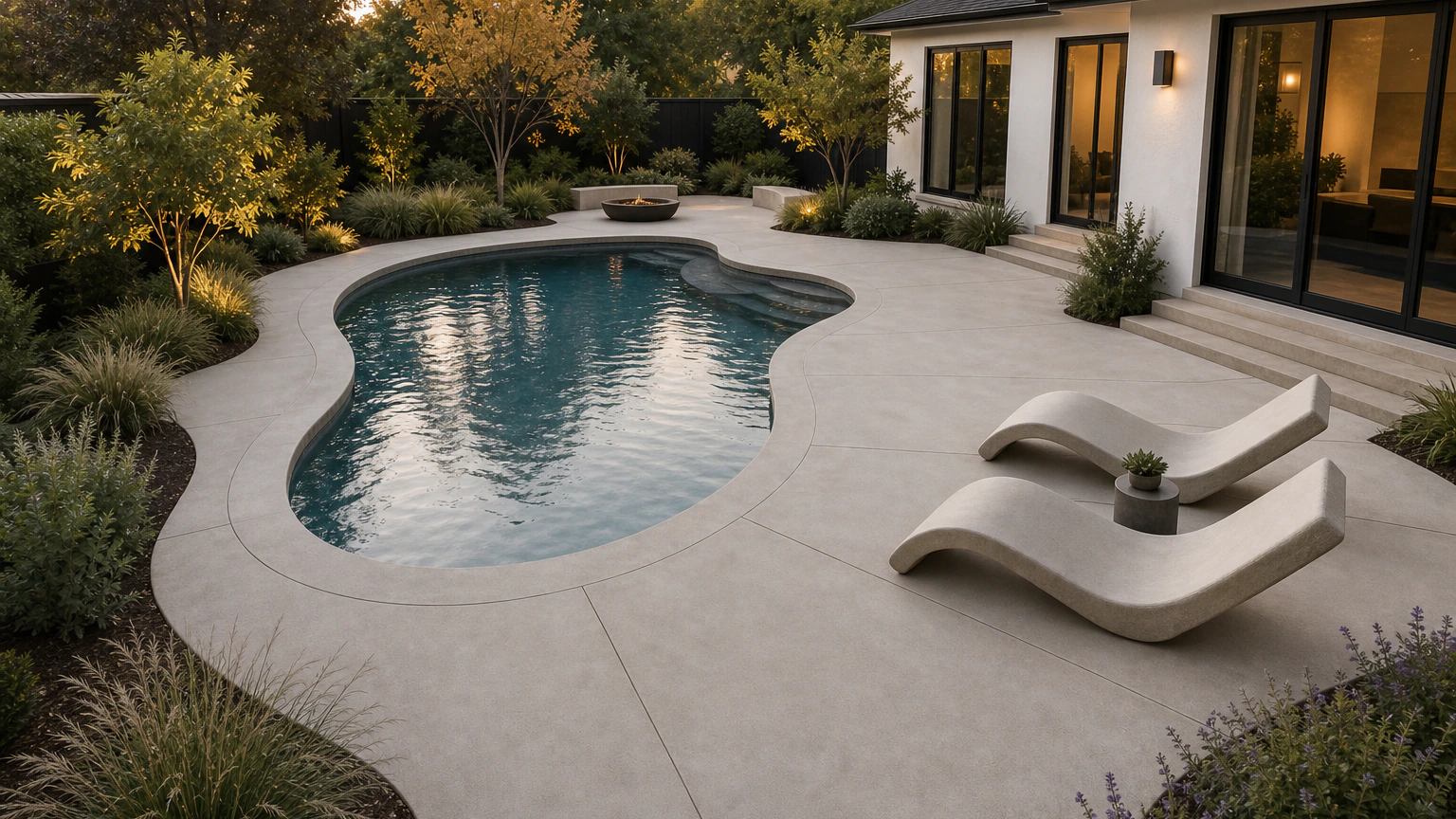
A gentle curve at the lounge end takes the edge off a rectangular pool and invites people to gather rather than line up along a straight wall. Warm gray keeps the surface easy to live with, and low grasses soften the boundary without dropping much debris into the water.
- The tradeoff
- The layout sets a clear direction, but it also commits the project to fixed relationships. Lay out the curve and its joints on the ground before committing forms, so it still works with chairs and walking routes.
- How to measure it
- Conceptual range: a main deck field plus a curved lounge apron measured as its own shape, not averaged into the rectangle.
On your property
Plan it for your site
A soft curve only looks intentional when it is broad and the joints follow it cleanly, so lay out the centerline full-size before forming. Keep the finish a fine, even texture; a curved edge plus a busy stamp reads as fussy.
- Keep the curve broad enough to form and finish cleanly and to avoid thin, fragile slivers of concrete.
- Place lounge chairs where the curve gives them a view of the water without blocking the walking loop.
- Choose grasses that tolerate splash and stay low so they do not shed into the pool.
Before forms are set
Build implications
- Confirm before estimating The curve radius, joint layout, and where furniture actually lands.
- Confirm before estimating Slope away from the pool across the curved apron.
- Confirm before estimating Plant selection for splash tolerance and low leaf-drop.
- Measure the site and establish elevations Record boundaries, thresholds, grade changes, utilities, and the dimensions of vehicles, furniture, equipment, or structures that affect the layout.
- Test how the space will be used Check walking routes, turning paths, door swings, working clearances, maintenance access, and the route back to the house or street.
- Resolve drainage, services, and structural support Decide where water goes and coordinate drains, conduit, irrigation, fuel, electrical work, footings, and independent supports before forms are set.
- Define and estimate each concrete element Confirm the slab or footing section, base, joints, edges, and finish, then estimate simple measurable fields separately from steps, walls, drains, and supported features.
Prevent these problems
- Choosing the finish by appearance aloneA surface that looks refined may become slippery when wet or uncomfortably hot in full sun.
- Draining toward the pool or houseSplash-out and rainfall need a deliberate route that avoids coping, thresholds, and low deck corners.
- Adding barriers after the layoutRequired fences, gates, alarms, and clear walking routes should shape the deck from the beginning.
Next step
Turn the idea into your estimate
Enter measurements from the property. The conceptual image does not provide a takeoff.
Estimate a similar pool deckQuestions this idea raises
Are curved pool decks harder to build?
A broad, simple curve is very buildable, but tight or complex curves add forming and finishing work and can create weak thin sections. Keep the geometry generous and lay it out before forming.
How do I estimate a curved deck?
Break it into a rectangle plus the curved apron and measure the apron on its own. A visual curve is a design direction, not a single takeoff.
- Best when
- Modern decks
- Reconsider when
- Reconsider the idea if wet traction, surface temperature, drainage, coping, and barrier requirements cannot be resolved on the property.
- Verify first
- Lay out the curve and its joints on the ground before committing forms, so it still works with chairs and walking routes.
- Professional input
- Pool and concrete contractors; verify local pool-safety requirements
Sources and further reading
- American Concrete InstituteTechnical references for exterior concrete, finishing, and durability in a wet, sunny setting.
- NRMCA CIP 6: Joints in Concrete Slabs on GradeA concise reference for planning control joints so a large deck cracks where you intend.
- Pool Safely (U.S. CPSC)Federal drowning-prevention and barrier guidance to build into any poolside layout.