Design decision
Why this idea works
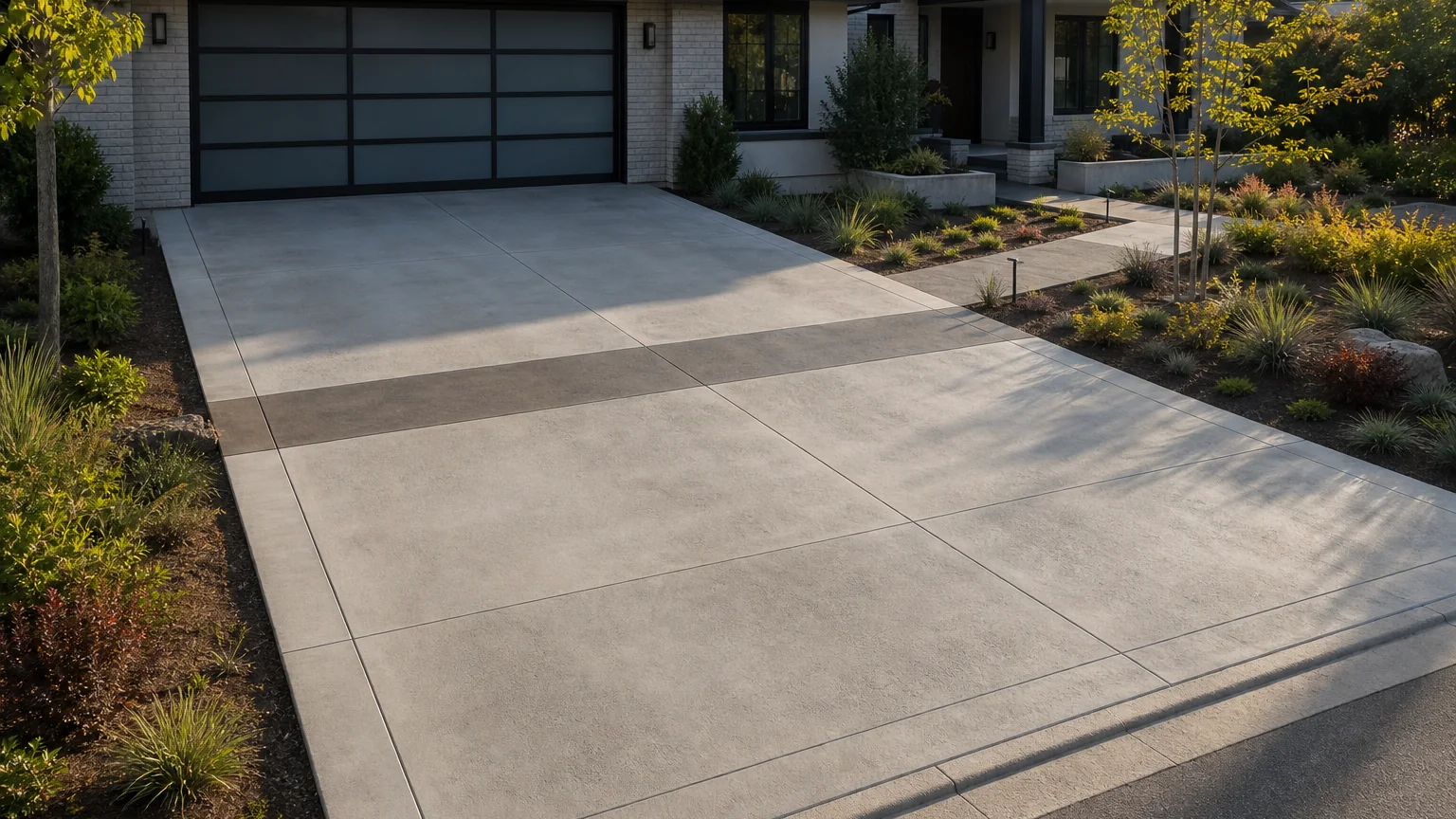
Where the front walk meets the drive, a marked crossing band tells drivers and walkers where people cross and gives guests an obvious route to the door. The contrast reads clearly without a sign and keeps foot traffic from wandering across the tire path.
- The tradeoff
- The band clarifies where people cross, but drivers and walkers still need sightlines and a route free of parked vehicles.
- How to measure it
- Conceptual range: the driveway rectangle plus a separately measured crossing band aligned with the walk.
On your property
Plan it for your site
Detail the crossing band as a real material or color change set flush with the drive so it does not become a trip edge, and align it with the front walk. Keep the surrounding drive a simple field so the band stands out as intended.
- Set the crossing band flush with the drive so it marks the route without a trip edge.
- Align the band with the front walk so the crossing reads as one continuous route.
- Keep the contrast clear enough to signal the crossing to drivers and walkers.
Before forms are set
Build implications
- Confirm before estimating A flush crossing band with no trip edge.
- Confirm before estimating Alignment between the band and the front walk.
- Confirm before estimating Contrast that reads clearly as a crossing.
- Measure the site and establish elevations Record boundaries, thresholds, grade changes, utilities, and the dimensions of vehicles, furniture, equipment, or structures that affect the layout.
- Test how the space will be used Check walking routes, turning paths, door swings, working clearances, maintenance access, and the route back to the house or street.
- Resolve drainage, services, and structural support Decide where water goes and coordinate drains, conduit, irrigation, fuel, electrical work, footings, and independent supports before forms are set.
- Define and estimate each concrete element Confirm the slab or footing section, base, joints, edges, and finish, then estimate simple measurable fields separately from steps, walls, drains, and supported features.
Prevent these problems
- A marked crossing with no clear approachThe visual band cannot help when planting, cars, or drainage force people to enter it from an unsafe angle.
What changes the work and quote
- Contrasting material or finish, joint coordination, and walk connectionsKeep it simpler: Use aligned saw cuts and lighting to mark a flush concrete route.
Next step
Turn the idea into your estimate
Enter the dimensions and section for your property. The image does not provide a takeoff.
Estimate your drivewayQuestions this idea raises
Why mark a pedestrian crossing on a driveway?
It tells drivers and walkers where people cross and gives guests an obvious route, which keeps foot traffic off the tire path and out of blind spots. The contrast does the work of a sign.
How do I keep the band from tripping people?
Detail it flush with the drive as a color or fine material change rather than a raised strip. Plan the levels so it marks the route without a lip.
- Best when
- The main walking route must cross the drive and a flush visual band can make that route easy to find.
- Reconsider when
- The band creates a raised lip, slick finish, confusing joint, or false sense of protection from moving cars.
- Verify first
- Place the crossing on the natural route, check parked-car visibility, and keep the surface flush and slip resistant.
- Professional input
- A concrete contractor should confirm the slab, base, joints, and drainage. Ask an engineer or the local authority to review retaining work, structures, unusual loads, or public-right-of-way changes.
Sources and further reading
- NRMCA CIP 6: Joints in Concrete Slabs on GradeJoint spacing, panel shape, isolation, and saw-cut depth for slabs on grade.
- FHWA: Bases and Subbases for Concrete PavementsProfessional guidance on uniform support, subgrade risks, drainage, and stable base layers.
- U.S. Access Board: Accessible RoutesSurface, slope, clear-width, and route guidance where formal accessibility rules apply.