Design decision
Why this idea works
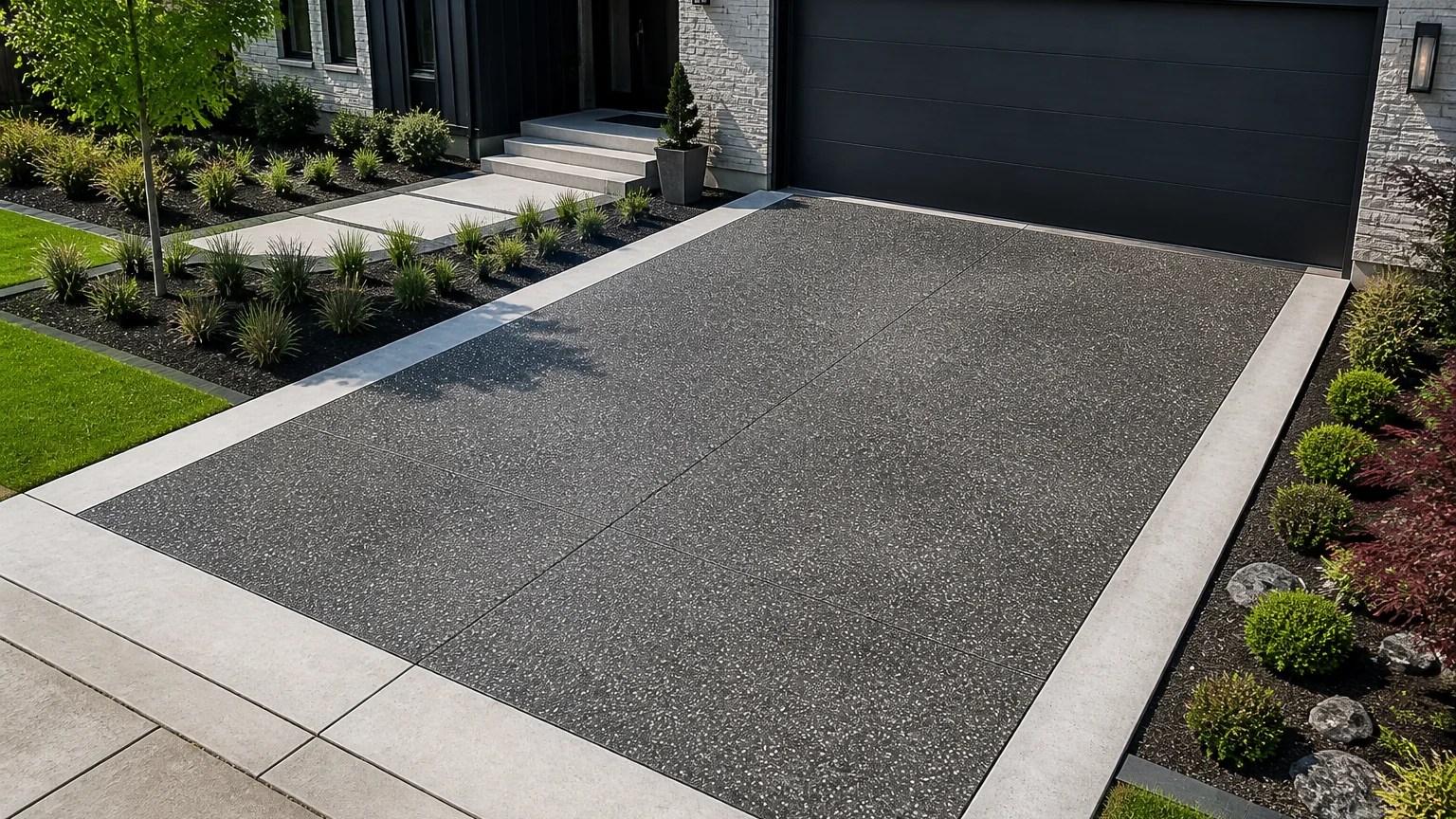
The dark aggregate field feels contemporary and hides tire marks well, while the pale edge band frames it and gives the drive a clean, resolved outline instead of a raw lawn edge. The contrast is the whole point, and it reads as deliberate design.
- The tradeoff
- Dark aggregate creates contrast, but it can show light debris and makes future color matching harder.
- How to measure it
- Conceptual range: the dark driveway field plus a separately measured pale edge band by its running length and width.
On your property
Plan it for your site
Keep the charcoal field an even exposure so the tone stays consistent, and pour the pale edge as its own band with a clean joint against the field. Seal both so the colors hold, and confirm the dark surface manages heat in full sun where you park.
- Keep the dark field exposure even so the tone does not blotch across the drive.
- Detail the pale edge band as its own pour with a clean joint to the field.
- Note that a dark surface holds more heat, and confirm it suits your climate and bare-foot areas.
Before forms are set
Build implications
- Confirm before estimating A sample showing the dark field and pale band together, sealed.
- Confirm before estimating A clean joint and matched levels between field and edge.
- Confirm before estimating Heat and drainage performance of the dark surface in your climate.
- Measure the site and establish elevations Record boundaries, thresholds, grade changes, utilities, and the dimensions of vehicles, furniture, equipment, or structures that affect the layout.
- Test how the space will be used Check walking routes, turning paths, door swings, working clearances, maintenance access, and the route back to the house or street.
- Resolve drainage, services, and structural support Decide where water goes and coordinate drains, conduit, irrigation, fuel, electrical work, footings, and independent supports before forms are set.
- Define and estimate each concrete element Confirm the slab or footing section, base, joints, edges, and finish, then estimate simple measurable fields separately from steps, walls, drains, and supported features.
Prevent these problems
- A border that traps movement or waterA rigid accent edge on poor support can settle apart from the field or hold runoff along the joint.
What changes the work and quote
- Dark aggregate or color, separate border placement, and sealingKeep it simpler: Keep the field natural gray and use a dark joint seal or planting edge for contrast.
Next step
Turn the idea into your estimate
Enter the dimensions and section for your property. The image does not provide a takeoff.
Estimate your drivewayQuestions this idea raises
Does a dark driveway get too hot?
Darker surfaces absorb more heat than pale ones, which matters where people stand barefoot or in hot climates. It is fine for a driving surface; test comfort if the area doubles as a play or lounge spot.
How do I get a crisp color edge?
Pour the edge band as its own element with a planned joint and matched level to the field, rather than trying to color half of one pour. Test the pairing on a sample first.
- Best when
- A contemporary house can carry a dark field and the pale border can follow stable slab edges and joints.
- Reconsider when
- The driveway receives intense sun, makes dust more visible, or needs a finish that is simple to color-match.
- Verify first
- Review a cured outdoor sample in sun and shade, then coordinate the border with joints and drainage.
- Professional input
- A concrete contractor should confirm the slab, base, joints, and drainage. Ask an engineer or the local authority to review retaining work, structures, unusual loads, or public-right-of-way changes.
Sources and further reading
- NRMCA CIP 6: Joints in Concrete Slabs on GradeJoint spacing, panel shape, isolation, and saw-cut depth for slabs on grade.
- FHWA: Bases and Subbases for Concrete PavementsProfessional guidance on uniform support, subgrade risks, drainage, and stable base layers.
- NRMCA CIP 11: Curing In-Place ConcretePlain-language guidance on curing methods, timing, weather, and surface protection.