Quick answer
Use this hub when the project is supported by a round pier, post footing, or reinforced concrete column. The estimate begins with a known inside diameter or section size and ends before the design of the reinforcement cage or connection hardware.
Frequently asked questions
Can the same estimate rule be used for piers and columns?
Only at the level of basic geometry. The support, reinforcement, and design assumptions are different enough that the two types are easier to review as separate estimating problems.
When should a pier or column be split into multiple quantities?
Whenever bases, capitals, pedestals, or section sizes change enough that the main prism or cylinder no longer describes the whole concrete shape.
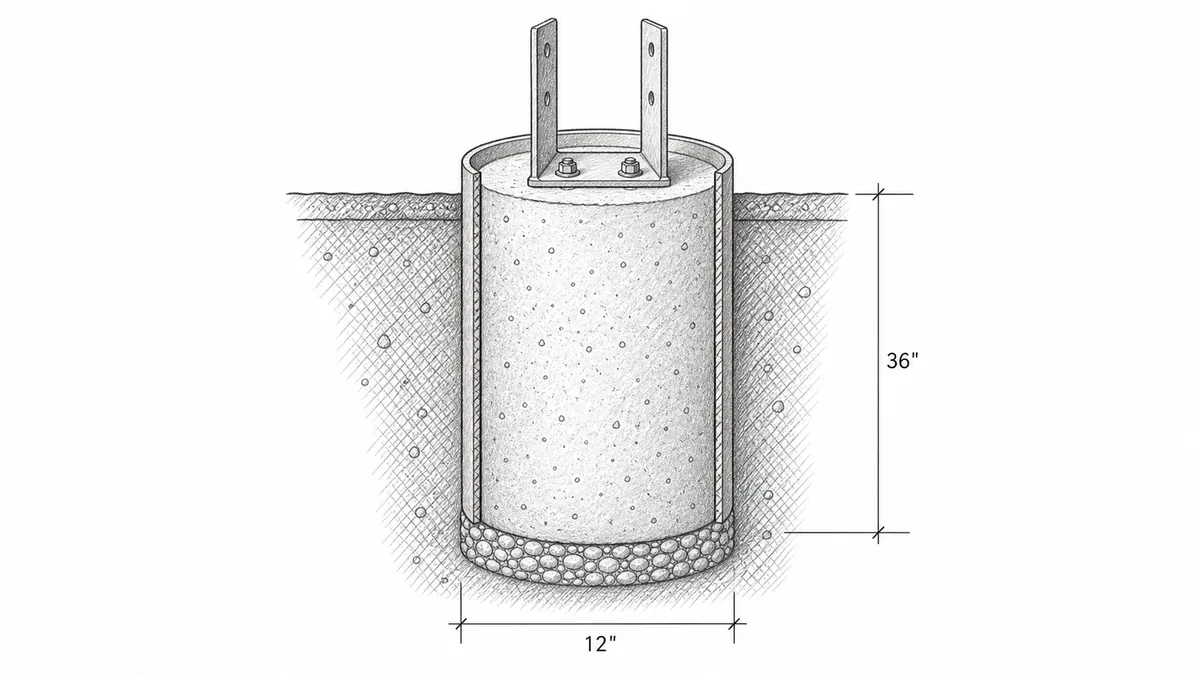
Engineering boundaries stay in force. The calculator can estimate concrete and some reinforcement quantities you enter, but it does not design the pier base, column cage, or load path.
| Element | Start here | Main boundary |
|---|---|---|
| Round pier in a tube form | Sonotube pier planning | Frost, overbreak, and base geometry are separate from the main cylinder |
| Square, rectangular, or round column | Concrete column planning | Cage layout and structural detailing come from the drawings |
Planning sequence
- Confirm whether the element is a pier, pedestal, or structural column.
- Measure the uniform concrete section only between actual pour limits.
- Separate flares, pedestals, capitals, and other nonuniform shapes.
- Use the structural detail for reinforcement, cover, and hardware assumptions.
- Verify bearing depth, uplift, and local review requirements before ordering.