Quick answer
Use this hub when the estimate follows a standard section over a long run. Curb, gutter, and related sitework are usually measured as cross-sectional area times length, but that logic breaks whenever the section changes.
Frequently asked questions
Why are transitions treated as separate items?
Because the section stops being uniform once the curb or gutter changes shape, and that is exactly where a simple linear estimate becomes unreliable.
Can driveway or sidewalk tie-ins stay inside the curb quantity?
Usually not. They often use different thicknesses, details, or drainage assumptions, so they are easier to review when they stay as related but separate line items.
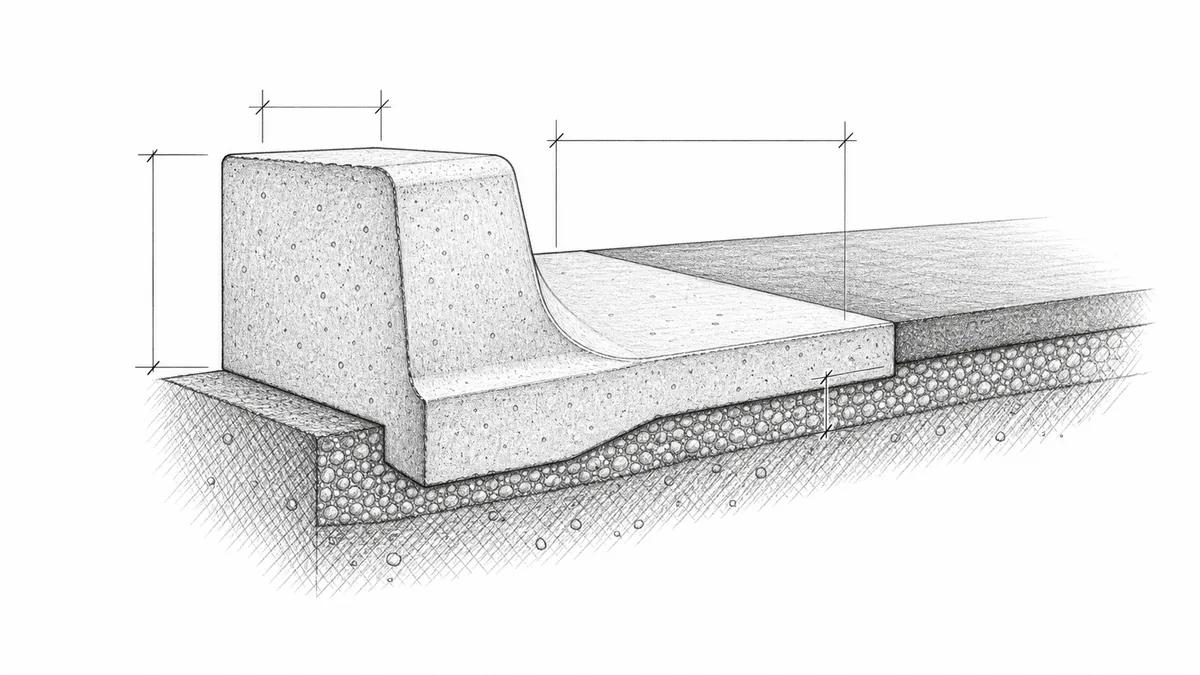
Municipal details often control. Curbs, gutters, ramps, and street-edge transitions may be governed by public-works standards or project sheets that override any generic rule of thumb.
| Need | Start here | Main risk |
|---|---|---|
| Uniform curb-and-gutter run | Curb and gutter planning | Transitions, returns, and inlets hidden inside one average section |
| Adjacent driveway or walk tie-in | Driveway thickness and base or sidewalk joints and thickness | Different support and thickness assumptions meeting the site-edge work |
Planning sequence
- Start with the approved standard detail for the section you are placing.
- Measure reference-line length only while the section stays uniform.
- Break out ramps, returns, crossings, and inlet transitions as separate items.
- Confirm drainage intent and public interface requirements before ordering.
- Review access, traffic control, and weather timing with the placing team.